Data Science + Generative AI

Python • Statistics • SQL • Machine Learning • Deep Learning • GenAI • MLOps

NumPy Pandas Scikit-learn TensorFlow / Keras RAG & LLMs AWS Deployment

Enroll Now

Get 20% off - Limited Time Offer


Course Duration

4 Months

Structured learning path

01
Curriculum

18 Modules

Step-by-step learning

02
Hands-On

Real-Time Projects

Build practical applications

03
Career Support

Interview Prep

Placement-focused guidance

04
Complete Curriculum

Data Science Learning Roadmap

18 practical modules planned across a 16-week learning path. Click any module to view the topics covered.

Modules
Month 1
Month 2
Month 3
Month 4
Learning Plan
W1
W2
W3
W4
W5
W6
W7
W8
W9
W10
W11
W12
W13
W14
W15
W16

Python Foundations for Data Science

  • Python syntax, variables, data types and operators
  • Conditional statements, loops and functions
  • Lists, tuples, dictionaries and sets
  • Object-oriented programming fundamentals
  • Working with files, exceptions and reusable modules

NumPy for Numerical Computing

  • NumPy arrays, dimensions and data types
  • Array indexing, slicing and reshaping
  • Vectorized operations and broadcasting
  • Mathematical, statistical and linear algebra operations
  • Performance-oriented numerical computing

Pandas for Data Analysis

  • Series and DataFrame fundamentals
  • Importing CSV, Excel, JSON and database data
  • Filtering, sorting, grouping and aggregation
  • Merging, joining and concatenating datasets
  • Time-series and categorical data handling

Data Cleaning & Preprocessing

  • Handling missing values and duplicate records
  • Outlier detection and treatment
  • Data type conversion and normalization
  • Encoding categorical variables
  • Building reusable preprocessing pipelines

Statistics & Probability

  • Descriptive statistics and data distributions
  • Probability concepts and Bayes theorem
  • Sampling methods and confidence intervals
  • Correlation, covariance and statistical relationships
  • Probability distributions for data science

Hypothesis Testing & Statistical Inference

  • Null and alternative hypotheses
  • Z-test, t-test and chi-square test
  • ANOVA and comparison of groups
  • P-values, significance and confidence levels
  • A/B testing for business decisions

Exploratory Data Analysis & Visualization

  • EDA workflow and analytical thinking
  • Matplotlib and Seaborn visualizations
  • Univariate, bivariate and multivariate analysis
  • Business storytelling with charts
  • Creating insight-driven analytical reports

SQL for Data Science

  • SQL fundamentals and relational databases
  • SELECT, WHERE, GROUP BY and HAVING
  • Joins, subqueries and CTEs
  • Window functions and analytical queries
  • Connecting Python with SQL databases

Machine Learning Fundamentals

  • Supervised vs unsupervised learning
  • Training, validation and test datasets
  • Bias, variance, overfitting and underfitting
  • Feature engineering and feature selection
  • Scikit-learn workflow and ML pipelines

Regression Models

  • Simple and multiple linear regression
  • Polynomial regression
  • Regularization: Ridge and Lasso
  • Regression metrics: MAE, MSE, RMSE and R²
  • Real-time regression use cases and projects

Classification Models

  • Logistic regression
  • K-Nearest Neighbors
  • Decision trees and random forests
  • Support Vector Machines
  • Classification metrics, ROC-AUC and confusion matrix

Unsupervised Learning

  • K-Means clustering
  • Hierarchical clustering
  • DBSCAN
  • Principal Component Analysis
  • Customer segmentation and pattern discovery projects

Ensemble Learning & Model Optimization

  • Bagging and boosting concepts
  • Random Forest, XGBoost and Gradient Boosting
  • Hyperparameter tuning with GridSearchCV and RandomizedSearchCV
  • Cross-validation strategies
  • Model comparison and production selection

Deep Learning Foundations

  • Neural networks, neurons and activation functions
  • Forward propagation and backpropagation
  • TensorFlow / Keras fundamentals
  • Building and training dense neural networks
  • Regularization, dropout and model optimization

NLP, Computer Vision & Modern AI

  • Text preprocessing and vectorization
  • Sentiment analysis and text classification
  • CNN fundamentals for image data
  • Transfer learning concepts
  • Introduction to transformers and modern AI models

Generative AI for Data Scientists

  • LLMs and prompt engineering fundamentals
  • Using ChatGPT, Claude and Gemini for analytics workflows
  • Embeddings and vector databases
  • RAG-based analytical applications
  • LangChain and LlamaIndex fundamentals

MLOps, APIs & Cloud Deployment

  • Saving and serving trained ML models
  • Building prediction APIs with Flask / FastAPI
  • Git and GitHub workflow for data science
  • Docker fundamentals for ML applications
  • AWS deployment, monitoring and model lifecycle concepts

Capstone Projects & Placement Preparation

  • End-to-end real-world Data Science capstone project
  • Business problem definition and dataset preparation
  • Model building, evaluation and deployment
  • GitHub portfolio, resume and LinkedIn project presentation
  • Mock interviews, case studies and placement preparation
Select a module to view the detailed topics.

Capstone Projects

Practice real application flows while building projects you can discuss during interviews.

We Learn – Groceries Application

We Learn – Food Application

We Learn – Banking Application

We Learn – Delivery Application

We Learn – Airlines Application

We Learn – LMS Application

Learn the AI Tools Used by Modern Developers

Use AI to code faster, solve problems, build projects, prepare for interviews and stay ready for modern software jobs.

✦ChatGPT
Claude
GeminiGemini
GitHub Copilot
Cursor AI
PerplexityPerplexity
AIOpenAI API
LangChain
🤗Hugging Face
ReplitReplit AI
Windsurf AI
AI Agents

AI for Coding

Write, debug and understand code faster with modern AI coding assistants.

AI for IT Jobs

Prepare resumes, interviews, projects and workplace tasks using AI.

AI for Career Growth

Stay updated with tools used by developers, startups and product teams.

Our Alumni

Surya

Surya

Infosys
Farhath

Farhath

L&T
Manasa

Manasa

Capgemini
Sana Lekana

Sana Lekana

Tech Mahindra
Ganesh

Ganesh

Genpact
Gnaneshwar

Gnaneshwar

Amazon
Ravi

Ravi

Hexaware
Harinath

Harinath

Adobe
Surya

Surya

Infosys
Farhath

Farhath

L&T
Manasa

Manasa

Capgemini
Sana Lekana

Sana Lekana

Tech Mahindra
Ganesh

Ganesh

Genpact
Gnaneshwar

Gnaneshwar

Amazon
Ravi

Ravi

Hexaware
Harinath

Harinath

Adobe
Ravi

Ravi

Hexaware
Harinath

Harinath

Adobe
Surya

Surya

Infosys
Farhath

Farhath

L&T
Manasa

Manasa

Capgemini
Sana Lekana

Sana Lekana

Tech Mahindra
Ganesh

Ganesh

Genpact
Gnaneshwar

Gnaneshwar

Amazon
Ravi

Ravi

Hexaware
Harinath

Harinath

Adobe
Surya

Surya

Infosys
Farhath

Farhath

L&T
Manasa

Manasa

Capgemini
Sana Lekana

Sana Lekana

Tech Mahindra
Ganesh

Ganesh

Genpact
Gnaneshwar

Gnaneshwar

Amazon

Frequently Asked Questions

Everything you need to know about our Data Science Training Program.

You will learn Python, NumPy, Pandas, data cleaning, statistics, probability, SQL, exploratory data analysis, machine learning, deep learning, NLP, computer vision, Generative AI, MLOps, APIs and cloud deployment.

No. The curriculum begins with Python foundations and progresses step by step through numerical computing, data analysis, statistics, SQL and machine learning.

Yes. The course includes descriptive statistics, probability, hypothesis testing, ANOVA, A/B testing, SQL fundamentals, joins, subqueries, CTEs, window functions and connecting Python with SQL databases.

Yes. It covers regression, classification, clustering, PCA, ensemble learning, random forests, XGBoost, gradient boosting, hyperparameter tuning and cross-validation.

Yes. The curriculum includes neural networks, TensorFlow/Keras, NLP, computer vision, CNN concepts, transfer learning, transformers and modern AI models.

Yes. You will learn LLM and prompt-engineering fundamentals, ChatGPT, Claude and Gemini for analytics workflows, embeddings, vector databases, RAG-based applications, LangChain and LlamaIndex fundamentals.

Yes. The curriculum includes model serving with Flask/FastAPI, Git and GitHub workflow, Docker fundamentals, AWS deployment, monitoring and model lifecycle concepts.

The final module includes an end-to-end real-world Data Science capstone, business problem definition, model building, evaluation and deployment, GitHub portfolio work, resume and LinkedIn presentation, mock interviews and case studies.

Ready to Start?

Join Moltres Institute Today

Career Insights

Developer Salary Growth

Course-wise salary growth comparison for Full Stack, Cloud, Data Science and AI career paths.

Certifications

Industry Recognized Certifications

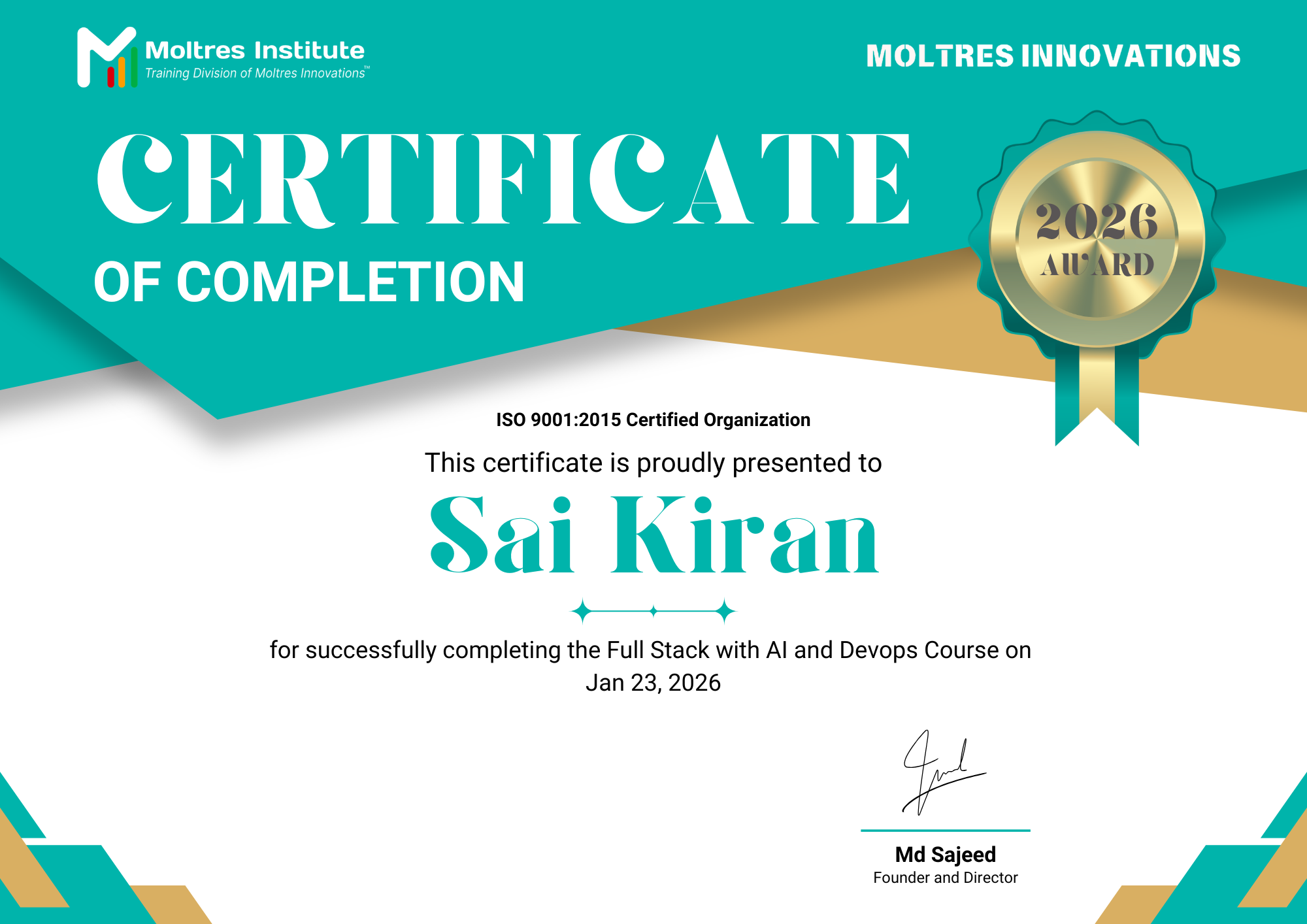
Course Completion Certificate

Get an industry-recognized certificate after successfully completing the course, boosting your career and job opportunities.

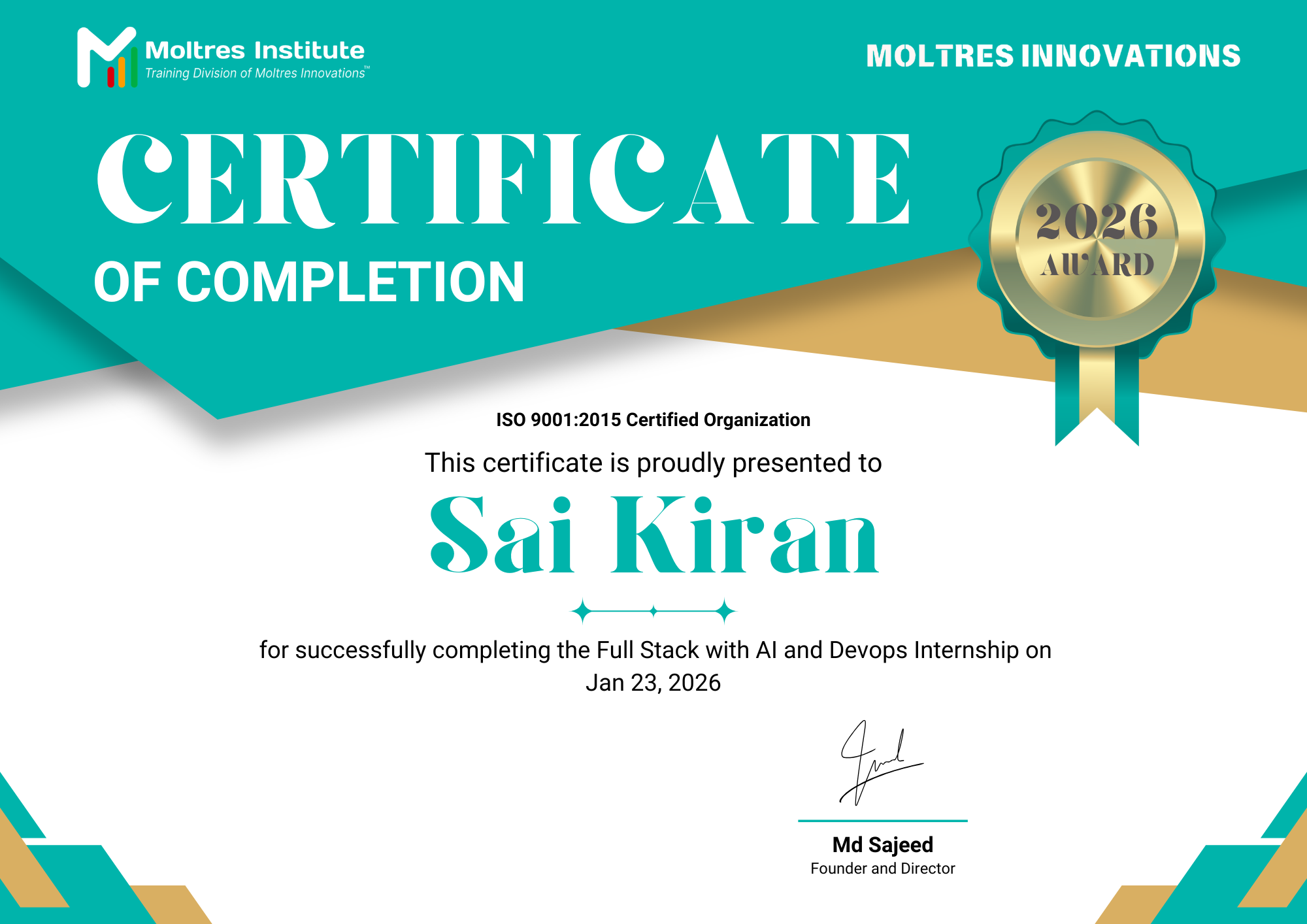
Internship Certificate

Gain real-time experience with internship certification that proves your practical skills and industry exposure.

Contact Us

Let’s Build Your Career Together

Reach out for course details, admissions, career guidance and placement support.

Admissions Support

Career & Admissions Support

Speak with our team for course counselling, batch details, 1:1 training guidance, project exposure and placement preparation.

Training Support:
Java Full Stack, Python Full Stack, MERN / MEAN, DevOps & AWS, Data Analytics and AI / ML programs.

Hyderabad

LVS Arcade, Madhapur Road,
HITEC City, Hyderabad - 500081

Call Us

+91 9177394286

Open Hours

Monday - Sunday
7:00 AM - 10:00 PM